
Ship
Implementing with base44
base44 is the alternative I reach for when it isn't Lovable. From where you sit, the flow barely changes — deploy the avatar, connect the MCP server, prompt "Implement Sanela from ASMI" — even though base44's internals differ from Lovable's in a couple of spots. So this chapter covers the two things worth your attention: what you actually do differently (connecting the MCP server), and the one under-the-hood difference worth understanding (how base44 runs the avatar's LLM calls). Everything else carries over from the Lovable chapter.
base44 connects MCP at the account level
Where Lovable adds connectors from inside a project's prompt box, base44 keeps MCP connections in your account settings, shared across every project.
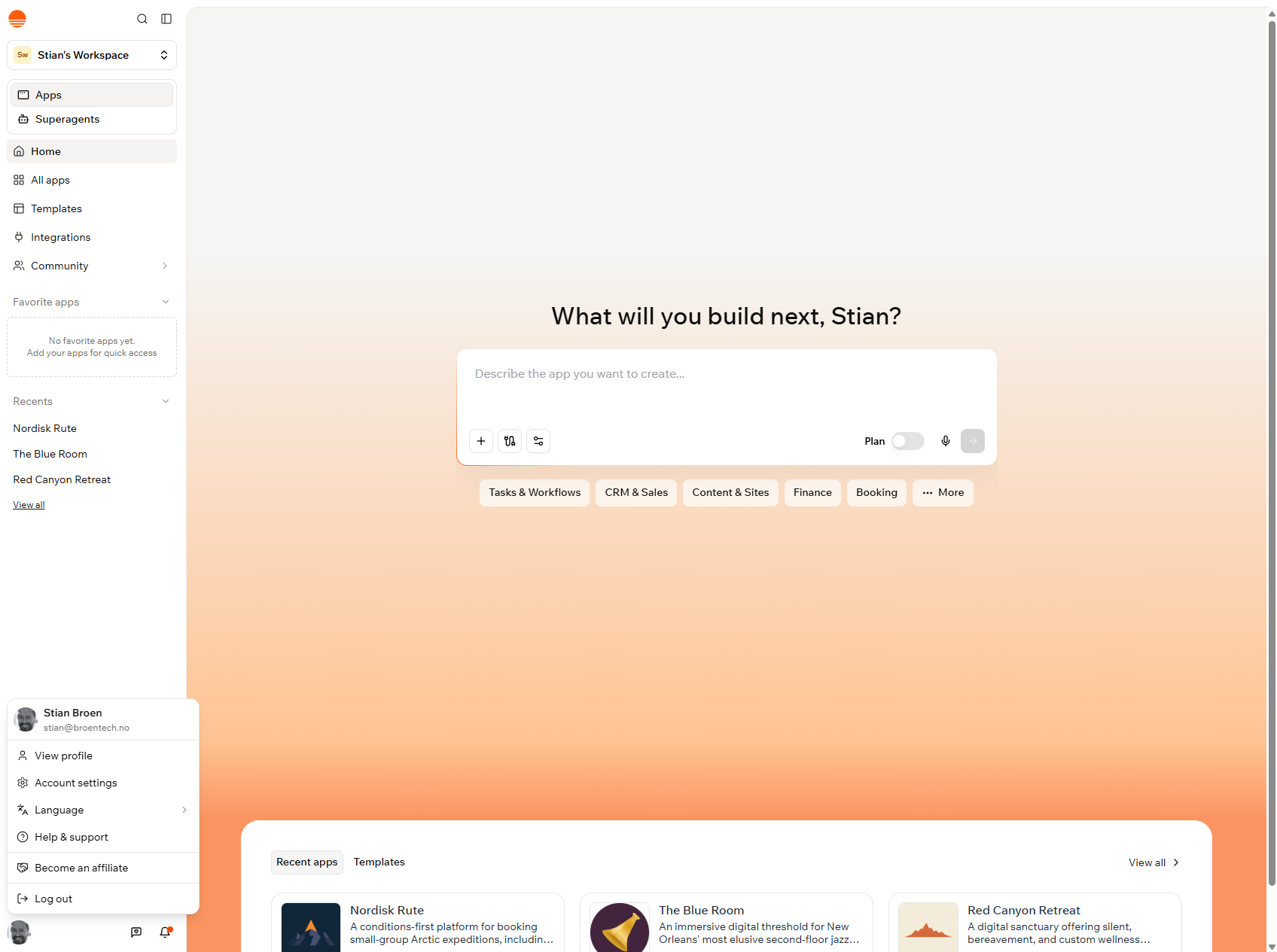
Open the account menu in the bottom-left of app.base44.com and click Account settings.
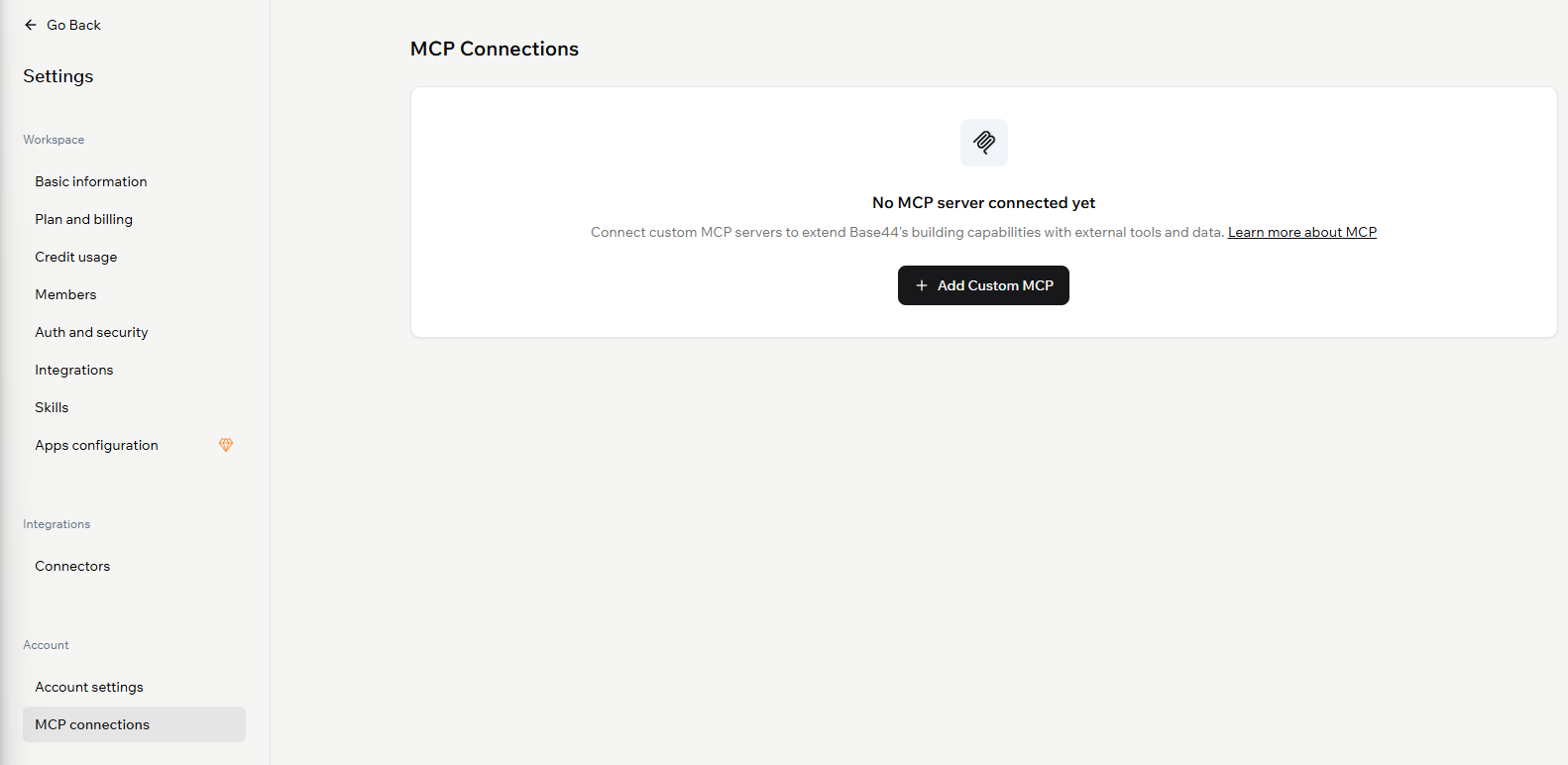
In Settings, find MCP connections in the left menu (under the Account group), then click + Add Custom MCP.
Authenticate with the x-api-key header
The Add custom MCP server dialog takes the same Name (e.g. ASMI) and URL (https://broen.tech/api/asmi/mcp) as Lovable. The one real difference is authentication: base44 has no bearer-token field. Instead, leave Authentication on Not required and add a Custom Header — key x-api-key, value your auk_… MCP API key. base44 sends that header on every request to the MCP server.
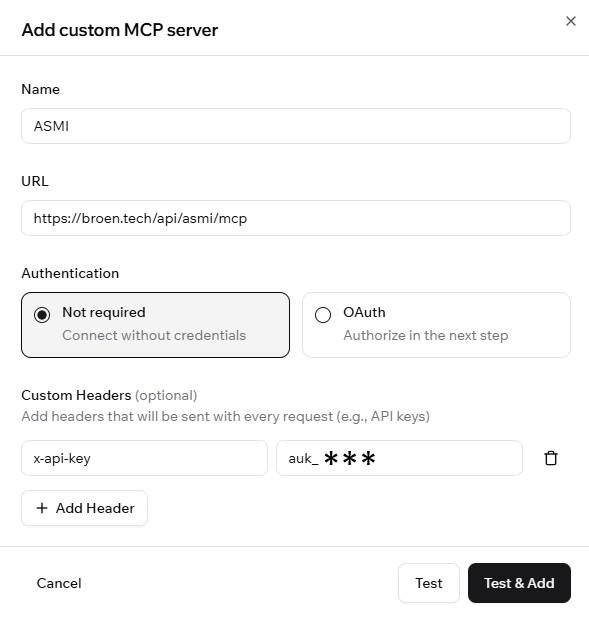
Click Test & Add. Because the connection lives at the account level, it's now available to every base44 project.
Build it the same way
Open your project and prompt the agent exactly as before — "Implement Sanela from ASMI" — and the rest of the Lovable chapter applies: the agent pulls the blueprint and embedding guide over MCP, writes the integration into your project, and you run a security pass before publishing. (base44 is one of the clients that truncates large MCP responses, so if the agent stalls on a partial definition, the same Copy full spec fallback from the deployment dialog gets you unstuck.)
The one internal difference — base44 runs the LLM its own way
On most hosts, the chat backend the agent writes reaches an LLM through a key you supply. base44 is built differently, and it's worth leaning into rather than fighting. Every base44 app can call InvokeLLM, a managed, built-in LLM integration — no API key, no provider account, no extra infrastructure; base44 selects the model (you can change it) and meters each call in its own integration credits. So on base44 the natural implementation lets the agent route the avatar's responses through InvokeLLM, exactly the way base44 intends apps to do AI. ASMI's runtime is provider-agnostic — it runs on whatever LLM the host hands it — so pointing it at InvokeLLM is a clean fit, and it leaves you one fewer secret to manage than the bring-your-own-key path on other hosts.
What comes next
One implementation chapter left: v0, whose custom-MCP connector supports custom headers much like base44's — the agent reads the embedding guide and writes the integration the same way.